What Is A Gen 3 Pickleball Paddle? - Paddles Generation Guide

What is a Gen 3 pickleball paddle?
A Gen 3 pickleball paddle is a thermoformed (heat-molded, sealed) paddle with a polymer honeycomb core and a ring of foam injected around its perimeter. That foam ring is what separates Gen 3 from Gen 2. Rackets & Runners compares it to the strings of a tennis racket: the ball sinks into the face, loads energy during the longer dwell time, and springs off with extra power and spin.
Gen 3 paddles took over the pro tour, then ran into trouble with honeycomb core crush and with power that grew as they broke in. Today's Gen 3 paddles are reinforced to fix those problems, and reviewers still rate them among the best-feeling paddles you can buy.
| Gen 3 at a glance | |
|---|---|
| Construction | Thermoformed unibody, sealed edges |
| Core | Polypropylene honeycomb, usually 14–16mm |
| Defining feature | Foam (usually EVA) injected around the core's perimeter |
| Strengths | Power, long dwell time, shapeable spin, rich feedback |
| Watch-outs | Core crush and break-in on older designs; certification status |
Pickleball paddle generations, explained
"Generation" is an industry shorthand for how a paddle is built, not an official USA Pickleball category. Each generation changed one main thing.
-
Gen 1Cold-pressed, glued
Honeycomb core
Edge guardInconsistent feel, small sweet spot -
Gen 2Thermoformed shell
Honeycomb core
Sealed edgesSolid and stable, bigger sweet spot -
Gen 3Thermoformed shell
Honeycomb core
+ foam perimeter ringMost power, long dwell, shapeable spin -
Gen 4Thermoformed shell
Full foam core
No honeycombNo core crush, muted, forgiving
Inside a Gen 3 paddle, and how it plays

- Power. The foam ring lets the face flex like a trampoline. Rackets & Runners says Gen 3 adds "another significant level" of power over Gen 2, anywhere on the court.
- Spin and dwell. The ball stays on the face longer, so you can shape it. Reviewers single out roll volleys, topspin drives and soft spin shots.
- Feel. Rich feedback and a crisp honeycomb response. Rackets & Runners finds Gen 4 more muted by comparison.
- Learning curve. More free power means resets and dinks take more touch, especially on a stiff, hollow Gen 3.
Gen 1 vs Gen 2 vs Gen 3 pickleball paddles
| Gen 1 | Gen 2 | Gen 3 | |
|---|---|---|---|
| How it's built | Cold-pressed and glued; edge guard | Thermoformed: heat-molded and sealed into one shell | Thermoformed, plus foam injected around the core |
| Core | Polymer honeycomb | Polymer honeycomb | Polymer honeycomb with a foam perimeter |
| How it plays | Inconsistent, "sloppy" feel, smaller sweet spot (Rackets & Runners) | Solid and stable, bigger sweet spot, more power | Trampoline-like: most power, longest dwell, shapeable spin |
| Tell-tale sign | Exposed polymer at the handle on budget models (Tickle My Pickleball) | Sealed, unibody handle | Foam visible at the perimeter when cut open (Ed Ju) |
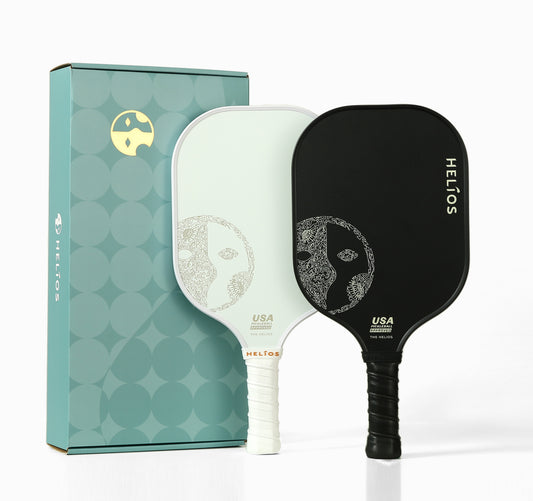
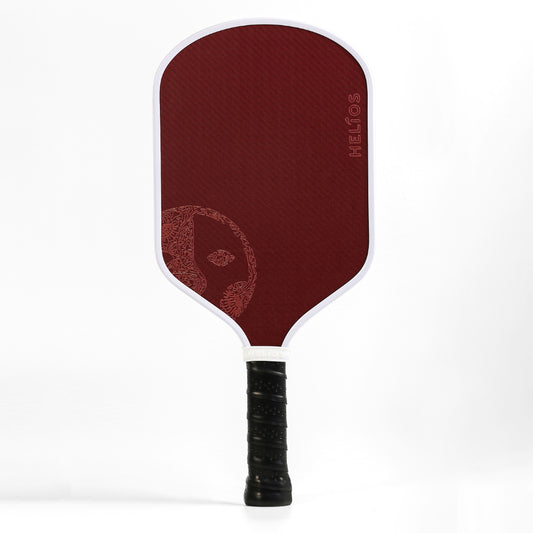
| Helios example | THE SELENE (13mm, not thermoformed) | THE APOLLO | BLAZE, FLARE, SOL |
| Gen 1 | Gen 2 | Gen 3 |
|---|---|---|
 |
 |
 |
Where Gen 4 fits. Gen 4 paddles replace the honeycomb with a full foam core, which removes core crush and usually gives a more muted, forgiving feel. Rackets & Runners still rates Gen 3 higher for dwell time and feedback. For the full story, see What Is a Gen 4 Pickleball Paddle?
Why were some Gen 3 pickleball paddles banned, and what is core crush?
The first Gen 3 paddles had two problems, according to Rackets & Runners:
- Too much power, and it grew. As the soft EVA foam broke in, it got softer and springier, so a worn Gen 3 hit even harder. Break-in was also uneven, leaving hot and dead spots on the face.
- Durability. EVA breaks down quickly against a rigid honeycomb core, and the honeycomb itself can crush.
That led to the "Gen 3 pickleball paddles banned" headlines. JOOLA's first Gen 3 paddles were removed from USA Pickleball's approved list, and USA Pickleball added a power test, PBCoR, that caps how much energy a paddle can return to the ball. Many original Gen 3 designs could not pass it, especially once broken in.
Core crush is when the honeycomb cells buckle. Ed Ju cut open two core-crushed paddles and found the honeycomb walls wavy and bent. Signs: a crackling sound when you press the face, and dead or extra-springy spots.
Pickleball Studio and Johnkew Pickleball add a competitive twist: a core-crushed Gen 3 often gets hotter, which can give its owner an edge, while a worn foam paddle usually goes dead.
Today's Gen 3 paddles, and the Helios take
Gen 3 did not disappear. Rackets & Runners notes that brands have since released reinforced Gen 3 lines. They are less powerful out of the box and far more resistant to break-in, yet still feel like Gen 3. Most pros were still using Gen 3 paddles at the time of that review.
That is the problem Helios set out to solve: keep the Gen 3 feel and power, and fix the core crush. Helios Pickleball developed a proprietary high-molecular reinforcement inside the honeycomb, which Helios states makes its core 4X more durable than a traditional honeycomb core. Helios backs the core with a lifetime warranty that replaces it at no charge. These are Helios's own claims, not independent results.
| Helios Gen 3 | Shape | Listed swing / twist weight | Best for | Price |
|---|---|---|---|---|
| BLAZE | Widebody, 16 × 8 in | 109 / 7.69 | Forgiveness at the kitchen | $199 |
| FLARE | Hybrid, 16.5 × 7.5 in | 112 / 7.23 | All-court balance | $199 |
| SOL | Elongated, 16.5 × 7.5 in | 114 / 6.87 | Power and reach | $259 |
All three share a 16mm thermoformed build and Helios's ForceGrid carbon face. On Johnkew Pickleball's cannon setup (100 hits at 70 mph), Helios measured a 3.3% spin loss on ForceGrid in its own lab.

| BLAZE | FLARE | SOL |
|---|---|---|
 |
 |
|
An honest caveat: Gen 3 paddles still need a little break-in, and Helios's durability and power figures have not yet been independently tested. Shop the full Performance Paddles line.
How to choose the best Gen 3 pickleball paddle
- Check certification. Find the exact model on USA Pickleball's approved list. Gen 3 paddles certified before October 1, 2026 keep their status; newly certified paddles must also pass the 2,100 RPM spin test.
- Look for reinforcement. Ask how the brand prevents core crush and EVA break-down: reinforced honeycomb, denser perimeter foam, or a published durability test.
- Read the warranty. A Gen 3 that covers the core is protected against the generation's main weakness.
- Match the shape to your game. Widebody for forgiveness, hybrid for balance, elongated for reach and power.
- Expect a little break-in. Even modern Gen 3 paddles can change slightly in the first weeks.
How to check for core crush: hold the paddle by the edges and press firmly on the center of the face with your thumbs. A healthy paddle is silent. Crackling, a soft dent, or a spot that suddenly plays hotter or deader means the core is going.
FAQ
What is a Gen 3 pickleball paddle? A thermoformed paddle with a honeycomb core and foam injected around the perimeter, for extra power, dwell time and spin.
Were Gen 3 pickleball paddles banned? Some were. Early JOOLA Gen 3 paddles were removed from USA Pickleball's approved list, and a power test (PBCoR) was added. Many current Gen 3 paddles are approved; check the exact model.
What is the difference between Gen 2 and Gen 3 paddles? Both are thermoformed. Gen 3 adds a foam ring around the core, which adds power and dwell but, on older designs, faster break-in.
Is Gen 3 or Gen 4 better? Neither for everyone. Gen 4 full-foam cores avoid core crush and feel more muted; Gen 3 offers more dwell and feedback. See What Is a Gen 4 Pickleball Paddle?
What is the best Gen 3 pickleball paddle? One that is certified, reinforced against core crush, covered by a strong warranty, and shaped for your game.
How long does a Gen 3 paddle last? It depends on the core and how hard you hit. Older designs were prone to core crush and fast break-in; reinforced designs are built to hold up longer.
Sources
- Rackets & Runners, What is the BEST technology in pickleball right now?
- Ed Ju, What's Inside Expensive Paddles?
- Pickleball Studio with John Kew, Gen 3 (polymer) vs Gen 4 (foam) Paddles
- Tickle My Pickleball, Are Temu Pickleball Paddles Worth It?
- Pickleball Effect, USAP's New Spin Rate Test (Jul 24, 2026)
- Helios Pickleball product specifications and in-house testing (power percentile, ForceGrid spin retention, reinforced honeycomb durability)