T700 Carbon Fiber Pickleball Paddles: What They Are & How to Choose

The short answer
T700 on a pickleball paddle means the face uses Toray's TORAYCA T700 carbon fiber (or a fiber sold as equivalent). It is a high-strength aerospace-grade fiber: Toray rates T700S about 39% stronger than its older T300 grade, with the same stiffness. On court, that strength mainly means a tough, consistent face. It does not, by itself, add spin or power.
Independent testing points the same way. In Pickleball Effect's controlled test, a T700 carbon face, a Kevlar face and a "titanium" face on otherwise identical paddles landed within 0.7 mph on serves and 12 RPM on spin. What decides how a T700 paddle plays is everything around the fiber: the surface texture, the core and the construction.
So a T700 paddle is a good sign, not a guarantee. Use the checklist below to judge the rest.
What does T700 mean on a pickleball paddle?
T700 is a grade name from Toray, the Japanese maker of TORAYCA carbon fiber. The letter and number identify the fiber's strength class; S and G suffixes mark versions with different sizing. Higher numbers are not simply "better": they trade strength, stiffness and price differently.

Two things follow from Toray's numbers:
- T700 is strong. T700S is rated at 4,900 MPa tensile strength and 2.1% strain, so the face can take repeated hard impacts.
- T700 is not stiffer than T300. Both are rated at 230 GPa. A T700 face will not feel stiffer or play crisper just because of the grade; stiffness comes from the layup, resin and core. Toray's T800 and T1100 grades are the stiffer ones.
Many paddles labeled "T700" don't state whether the fiber is genuine Toray or a T700-class equivalent. If the brand matters to you, ask the seller.
What actually decides spin, control and feel
The fiber grade is one layer of a paddle. Reviewers who test paddles side by side keep finding that other parts matter more.

| What you notice | What mostly controls it | What reviewers found |
|---|---|---|
| Spin | Surface texture (peel ply or grit) and dwell time | Johnkew Pickleball compared 138 raw-carbon and 23 Kevlar peel-ply paddles and found nearly identical average spin; spin is "all about the peel ply" |
| How long the spin lasts | Texture durability | Raw carbon peel ply wears gradually over weeks to months (Johnkew); durable-grit faces aim to last longer |
| Feel and consistency | Face layup and construction | STS Pickleball describes raw carbon as the most linear face shot to shot; fiberglass layers add pop |
| Power and pop | Core and construction (thermoformed, Gen 2/3/4) | The core changes speed far more than the face material |
| Forgiveness | Shape, weight and twist weight | Measured twist weight separates paddles more than face material |
That's why two "T700" paddles can play nothing alike. A cold-pressed 13mm T700 paddle and a thermoformed 16mm T700 paddle share a face fiber and little else.
Is a T700 pickleball paddle good?
Yes, as a face material: T700 carbon is strong, consistent and proven. It is the most common premium face for a reason. Just judge the whole paddle, not the label.
| Pros of a T700 carbon face | Cons and limits |
|---|---|
| High fiber strength (4,900 MPa per Toray) for a durable face | Same stiffness as cheaper T300, so no built-in "crisper" feel |
| Linear, predictable response shot to shot (STS Pickleball) | Raw peel-ply texture wears over weeks to months of play |
| Takes peel-ply or grit texture well, for strong spin | Spin depends on the texture, not the fiber |
| Widely used, so easy to compare across brands | "T700" is printed on many budget paddles, including cold-pressed Gen 1 builds |
Who it suits: almost everyone. Control and all-court players get a predictable face; power players get the same face on a livelier core.
Who might look elsewhere: players who want a softer, more muted face (a "titanium" PET face is plusher), or a firmer, more stable face (Kevlar raised twist weight in Pickleball Medicine's comparisons). See Are Kevlar Pickleball Paddles Worth It?
For the bigger picture on face and core materials, see our Carbon Fiber Pickleball Paddle Guide and What Is the Best Pickleball Paddle Material?
What to check before buying a T700 paddle
- Construction. Thermoformed, unibody paddles are sealed and more consistent. Press on the handle: Tickle My Pickleball found exposed polymer in a $20 knockoff's handle, a sign of a cold-pressed Gen 1 build.
- Approval. Check the paddle on USA Pickleball's approved list. Tickle My Pickleball notes that factories will print an approval stamp on request, so the stamp alone proves nothing.
- Surface texture and its durability. Look for published spin-retention data. Since October 1, 2026, newly certified paddles must test under 2,100 RPM in USA Pickleball's spin test, so be wary of big spin numbers without context.
- Core and thickness. 16mm plays softer with a bigger sweet spot; 13–14mm is quicker and livelier.
- Measured specs. Swing weight and twist weight tell you how the paddle will feel. Prefer brands that publish them, and check reviewer measurements where they exist.
- Price. Spend on construction (thermoformed, 16mm, good specs) before paying extra for a face label.
Helios T700 carbon fiber paddles
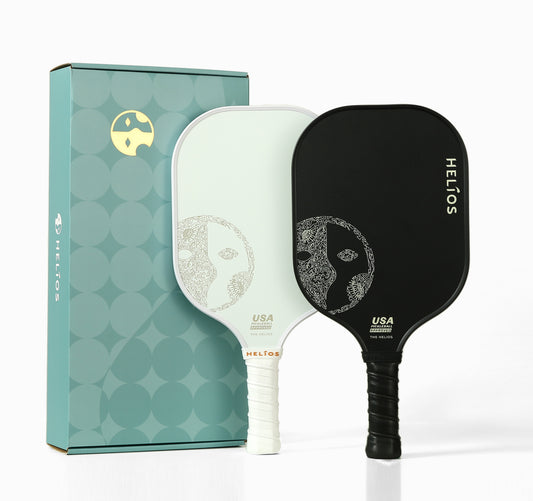
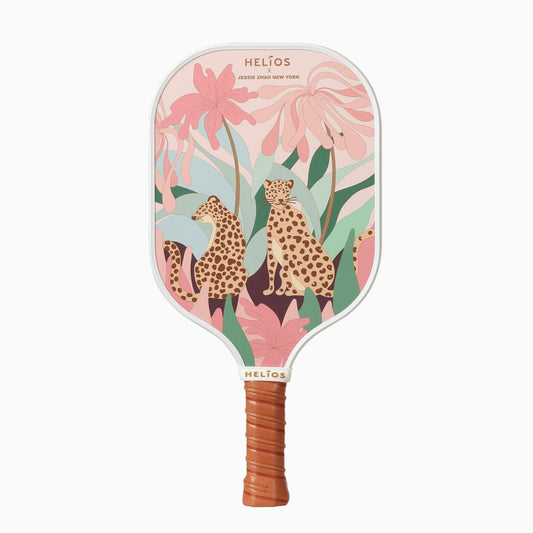
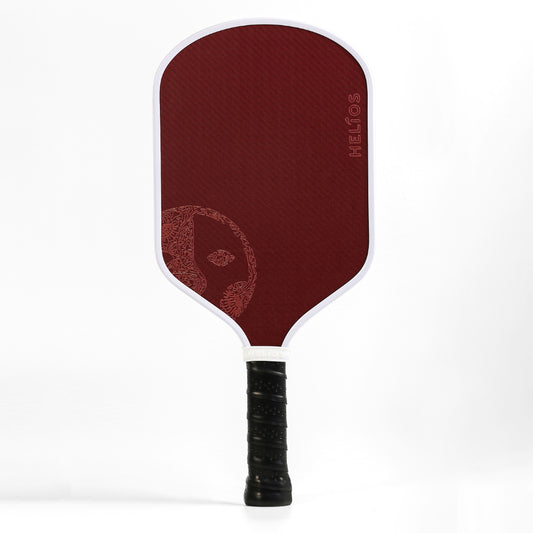
Three Helios paddles use a Toray T700 carbon face. Specs are Helios's listed figures.
| THE APOLLO | THE ASTRAEUS | THE SELENE | |
|---|---|---|---|
| Photo |  |
 |
 |
| Shape | Hybrid, 16.5 × 7.4 in | Elongated | Elongated, 16.4 × 7.5 in |
| Construction | Thermoformed unibody, foam-injected edge | Thermoformed unibody, foam-injected edge | Not thermoformed |
| Core | Accelerated core, 16mm | Accelerated core, 16mm | PP honeycomb, 13mm |
| Avg weight | 8 oz | 7.5 oz | 7.8 oz |
| Swing / twist weight | 108–121 / 6.9 | 108 / 6.2–6.5 | Not listed |
| Price | $229 | $229 | $79 |
| Best for | All-court players who want a predictable raw-carbon face | Players who want reach and a light swing | Budget buyers and newer players |
- THE APOLLO is the T700 paddle most players should start with: thermoformed, 16mm and a hybrid shape that balances reach and forgiveness.
- THE ASTRAEUS suits players who want a lighter, longer paddle; its listed twist weight is lower, so it is less forgiving on mishits.
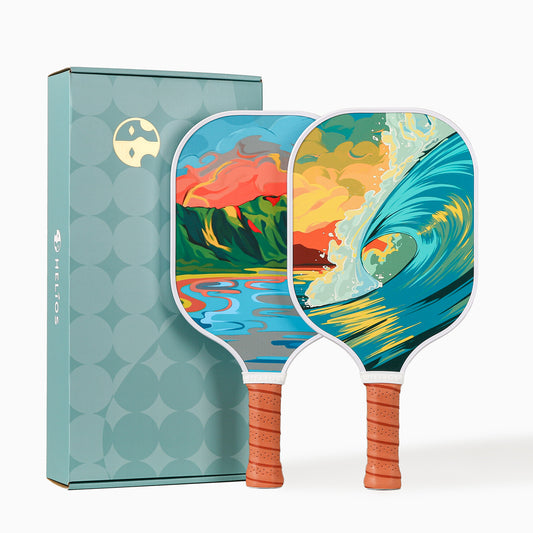
- THE SELENE puts a T700 face on a light 13mm build at $79, with two surface options. It is livelier and less stable than the thermoformed pair.
Helios also uses ForceGrid, a textured carbon face, on its Gen 3 paddles (BLAZE, FLARE, SOL). In Helios's own test on Johnkew Pickleball's cannon setup (100 hits at 70 mph), ForceGrid lost 3.3% of its spin; that is an in-house figure, not an independent one. Browse all carbon fiber paddles.
FAQ
What is a T700 pickleball paddle? A paddle whose face uses Toray T700 carbon fiber (or an equivalent), a high-strength fiber rated at 4,900 MPa tensile strength.
Is a T700 pickleball paddle good? The face is strong and predictable, but performance depends on the texture, core and construction. Check those before buying.
Is T700 better than T300? T700 is about 39% stronger, with the same 230 GPa stiffness. It won't feel stiffer; it should be tougher. See T700 vs T300.
Does T700 carbon fiber add spin? Not by itself. Reviewers found spin comes from the surface texture and dwell time; fiber type barely changes it.
How much does a T700 pickleball paddle cost? Anything from budget to premium. Helios T700 paddles run from $79 (SELENE) to $229 (APOLLO, ASTRAEUS); the construction drives most of the difference.
Is Toray T700 the same as T700 carbon? TORAYCA T700 is Toray's product. Some paddles use T700-class fiber from other makers; ask the brand if it matters to you.
Sources
- Toray Composite Materials America, Carbon Fiber Selector Guide and T700S Data Sheet
- Pickleball Effect, A Data-Driven Comparison of Titanium, Carbon Fiber, and Kevlar Paddle Faces and USAP's New Spin Rate Test (Jul 24, 2026)
- Johnkew Pickleball, KewCast 22: Kevlar vs carbon spin and Honolulu J6CR review
- STS Pickleball, What is the best surface material?
- Tickle My Pickleball, Are Temu Pickleball Paddles Worth It?
- Pickleball Medicine, The Truth About Kevlar Pickleball Paddles
- Helios Pickleball product specifications and in-house testing (ForceGrid spin retention)