What Makes a Thermoformed Pickleball Paddle Different—and Is It Worth It?
A thermoformed pickleball paddle is heat-molded into one sealed shell. The face wraps around the edge, and a foam-filled perimeter bonds the front and back faces together. Compared with an older cold-pressed paddle, that usually means a larger, steadier sweet spot, more pop and fewer cracked edges. We think thermoforming is worth paying for once you play regularly, and this guide explains why, where the trade-offs are, and when a cold-pressed paddle still makes sense.
What is a thermoformed pickleball paddle?
"Thermoformed" describes how a paddle is built, not what it is made of. A carbon fiber, Kevlar or fiberglass face can be thermoformed or not. In a thermoformed paddle, the faces, core and edge are pressed together inside a heated mold, so the paddle comes out as one piece instead of layers glued together.
In an interview with Pickleball Effect, a paddle-brand co-founder described the process as borrowed from carbon parts for bikes and cars. The key difference is a continuous carbon seam around the perimeter that joins the two faces, usually with foam injected along the edge.
How thermoformed paddles are made
The two builds share the first steps. The difference is what holds the paddle together:
- Cold press (traditional): the honeycomb core is cut to shape, the face sheets are glued on under pressure, and an edge guard is added afterwards. The faces are held together by the glue and the edge guard.
- Thermoformed: the core, faces and a carbon wrap around the edge go into a mold together. Heat and pressure cure them as one shell, and foam is added along the perimeter. The faces are held together by the shell itself.
Thermoformed vs regular paddles: the differences
| Cold-pressed (regular) | Thermoformed | |
|---|---|---|
| How it's built | Layers glued, edge guard added | One heat-molded shell |
| Edges | Edge guard; edges can crack or separate on older designs | Sealed carbon perimeter, often with edge foam |
| Sweet spot | Smaller, edges can feel dead | Larger and more stable on off-center hits |
| Feel | Softer, more muted | Stiffer, crisper, more pop |
| Break-in | Plays the same from day one | Feel can change over the first week or so |
| Price | Usually lower | Usually higher |
| Best for | Beginners, casual and budget players | Regular players, 3.0 and up |
The key benefits
We think three benefits are well supported by reviewers' testing and teardown videos:
- A more stable sweet spot. Rackets & Runners describes the first thermoformed paddles as more solid and rigid than glued paddles, with fewer gaps and a much bigger sweet spot. The sealed perimeter adds stability at the edges, which is where cold-pressed paddles often felt dead.
- Tougher edges and handles. In the Pickleball Effect interview, the co-founder explained that early raw-carbon cold-pressed paddles had problems with cracking edges and snapping handles. Bonding the faces with a continuous carbon seam was the fix.
- Less vibration. Players commonly describe thermoformed paddles as more stable and less buzzy on contact, and the host in that interview felt the same.
The drawbacks
We don't think thermoforming is a free upgrade. These trade-offs are real:
- Break-in. Thermoformed paddles often feel stiff for the first week or so of play. Some foam-perimeter (Gen 3) designs also got hotter as they broke in, which led to stricter power certification.
- The heat itself. A cold-press manufacturer interviewed on Matt's Pickleball argued that heat and pressure can weaken the honeycomb cells so they crush sooner, and that EVA foam shrinks with heat and can leave voids. That is one manufacturer's argument, backed by its own durability test, not an independent study. We include it because it is the strongest case on the other side.
- A firmer feel. If you like a soft, quiet, dwell-heavy touch, a stiff thermoformed paddle can feel harsh at first. A softer face (Kevlar) or a 16mm core helps.
- Price. The extra molding step costs more, and that shows up in the price.
The edge is where the two builds differ most. A thermoformed shell protects the edge and handle, but the honeycomb inside is still honeycomb, so core crush is still possible.
Is a thermoformed paddle worth it? Our take
We think the answer depends on how often you play:
- Playing once a week or learning the game: a well-made cold-pressed paddle is fine. You won't notice the sweet-spot gain as much as a regular player, and you save money.
- Playing two or more times a week, around 3.0 and up: we think thermoformed is worth it. The steadier sweet spot shows up in fast hands battles and off-center blocks, and the sealed edge holds up better to regular play.
- Power players: a thermoformed 16mm paddle is our pick, but check that it is on the current USA Pickleball approved list, since power is now capped by certification.
- Touch and control players: still thermoformed, but choose a softer face or a 16mm core rather than the stiffest raw carbon you can find.
How we build ours: thermoformed and cold-pressed Helios paddles
Rather than compare other brands, we think the clearest way to show the difference is with our own line, where we make both builds.
All six of our thermoformed paddles share a 16mm core and a sealed perimeter, so the shape decides most of the stability: the widebody BLAZE has the highest twist weight, and the compact ASTRAEUS trades some of it for speed.
| Paddle | Build | Face | Shape and size | Specs (Helios) | Best for |
|---|---|---|---|---|---|
| BLAZE | Thermoformed, unibody, edge foam | ForceGrid carbon | Widebody, 16 x 8 in | 16mm, 8 oz, SW 109, TW 7.69 | Most forgiveness at the kitchen |
| FLARE | Thermoformed, unibody, edge foam | ForceGrid carbon | Hybrid, 16.5 x 7.5 in | 16mm, 8 oz, SW 112, TW 7.23 | All-court balance |
| SOL | Thermoformed, unibody, edge foam | ForceGrid carbon | Elongated, 16.5 x 7.5 in | 16mm, 8 oz, SW 114, TW 6.87 | Reach and drives |
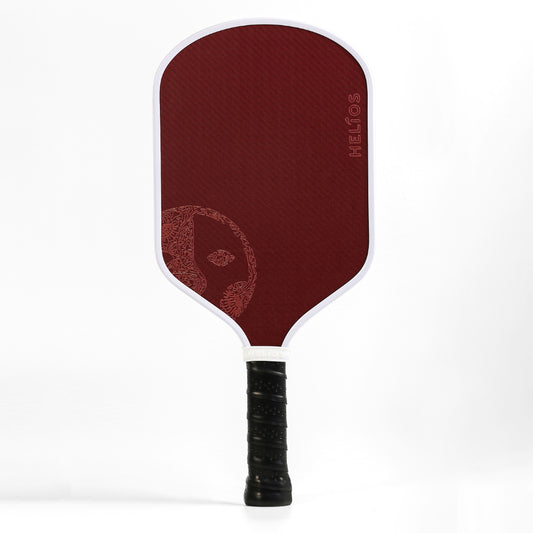
| THE APOLLO | Thermoformed, unibody | Toray T700 raw carbon | Elongated, 16.5 x 7.4 in | 16mm, 8 oz, SW 108–121, TW 6.9 | Spin-focused all-court play |
| THE ATHOS | Thermoformed, unibody | DuPont Kevlar | Elongated, 16.5 x 7.4 in | 16mm, 8 oz, SW 108–121, TW 6.9 | A softer thermoformed feel |
| THE ASTRAEUS | Thermoformed, unibody | Toray T700 carbon | Compact, 15.2 x 7.5 in | 16mm, 7.5 oz, SW 108, TW 6.2–6.5 | Quick hands |
| THE SELENE | Cold-pressed | Toray T700 carbon | 16.4 x 7.5 in | 13mm, 7.8 oz | A light, budget carbon paddle |
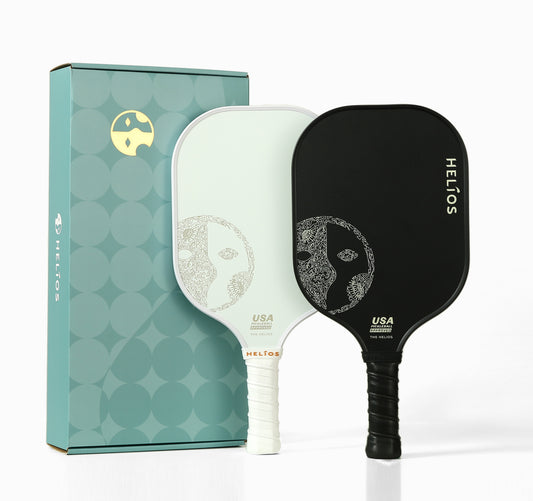
| THE HELIOS | Cold-pressed | Carbon fiber | Standard, 15.7 x 7.9 in | 13mm, 8 oz | Beginners and casual play |
Specs are Helios's published figures. Swing weight (SW) and twist weight (TW) vary from paddle to paddle and have not been measured independently.
How to tell if a paddle is really thermoformed
- Look at the handle. Ed Ju's teardown and Tickle My Pickleball's budget-paddle review both point to exposed honeycomb at the base of the handle as a sign of an unsealed, non-thermoformed build.
- Look at the edge. A thermoformed paddle has the face wrapping around a sealed perimeter, often with foam inside it, rather than a face that stops at a glued-on guard.
- Check the spec sheet. Brands that thermoform say so, often with "unibody" and "edge foam" alongside it.
- Check the approved list. A printed "USA Pickleball approved" mark is not proof. Search the paddle on the official USA Pickleball approved list.
FAQ
What is a thermoformed pickleball paddle? A paddle whose faces, core and edge are heat-molded together into one sealed shell, usually with a carbon seam and foam around the perimeter.
Are thermoformed pickleball paddles better? For regular players, we think so: they usually have a steadier sweet spot and tougher edges. They also cost more and need a short break-in, so a cold-pressed paddle is still a sensible choice for beginners.
Do thermoformed paddles have more power? Usually a little more pop than a cold-pressed paddle with the same face and core, but every approved paddle now has to pass USA Pickleball's power certification.
Do thermoformed paddles get core crush? They can. Thermoforming protects the edges, not the honeycomb itself. Some manufacturers argue the heat makes the honeycomb crush sooner, and that claim has not been independently tested.
How long does a thermoformed paddle take to break in? Reviewers commonly describe about a week of regular play before the feel settles.
Sources
- Pickleball Effect, interview with a paddle-brand co-founder on thermoforming
- Matt's Pickleball, interview with a paddle-brand CEO on cold press vs thermoformed
- Rackets & Runners, What is the best technology in pickleball right now?
- Ed Ju, What's inside expensive paddles?
- Tickle My Pickleball, Are Temu paddles worth it?
- Helios Pickleball product specifications (Shopify, November 2026)