Raw Carbon Fiber Pickleball Paddles: What They Are and Who Should Use One

The phrase "raw carbon fiber" shows up in nearly every paddle description in 2026. It is the most marketed face material in the sport right now. But most players do not know what "raw" actually means, how it differs from coated carbon fiber, or whether it matters for their game.
A raw carbon fiber pickleball paddle has an exposed, unfinished carbon fiber weave on the hitting surface. No protective paint. No clear coat. No smoothing layer. The woven texture of the carbon fiber itself is what contacts the ball. That exposed texture is what generates the spin numbers that paddle brands use in their marketing. Here is what that means for you on the court.
What Raw Carbon Fiber Actually Looks Like
If you run your thumb across a raw carbon fiber face, you feel the weave pattern. Small ridges and valleys are created by the overlapping carbon strands. That texture is not a coating applied to the surface. It is the structural material itself. The Helios performance line uses Toray T700 carbon fiber, one of the most recognized grades in the industry, with aerospace engineering origins dating back to 1926.
Compare that to a coated carbon fiber paddle, where a clear coat, UV finish, or textured paint covers the raw weave. The underlying material is the same carbon fiber. The difference is whether the surface you play with is the raw fiber or a layer on top of it.
Raw Carbon Fiber vs Carbon Fiber: The Real Differences
The raw carbon fiber vs carbon fiber pickleball paddle debate is really a raw vs coated debate. Both use carbon fiber. The question is what sits on the outermost layer, the part that touches the ball.
| Feature | Raw Carbon Fiber | Coated Carbon Fiber |
|---|---|---|
| Surface texture | Exposed weave, naturally gritty | Smooth to textured, depends on coating |
| Spin potential | Higher (more friction points per cm²) | Good, varies by coating technology |
| Durability | Wears faster (no protective layer) | Lasts longer (coating absorbs friction) |
| Feel | Grittier, more tactile feedback | Smoother, more uniform |
| Maintenance | Shows wear patterns sooner | Holds appearance longer |
| USAPA compliance | Must stay under 30 micrometers roughness | Same limit applies |
Both are legal. USA Pickleball caps surface roughness at 30 micrometers for all approved paddles, raw or coated. The spin difference between them is real but bounded by that legal limit. No raw face can be infinitely gritty. No coating eliminates spin.
Why Raw Carbon Fiber Generates More Spin
Spin comes from friction at the moment of contact. The ball presses against the paddle face for a fraction of a millisecond. During that window, the surface texture grabs the ball and imparts rotational force. More friction points on the surface mean more rotational force on the ball.
Raw carbon fiber has a naturally irregular surface. The woven strands create thousands of micro-ridges per square centimeter that act like tiny grip points. When the ball contacts these ridges, it catches and rolls rather than sliding. That catch-and-roll is what produces spin.
A coated face smooths over some of those micro-ridges. The coating fills the valleys between strands, reducing the number of friction points. Some coatings are engineered with their own texture to compensate, and modern coating technologies have narrowed the spin gap significantly. But for maximum out-of-the-box spin, raw carbon fiber still leads.
The Trade-Off: Spin vs Longevity
Here is where the decision gets practical. Raw carbon fiber wears faster because the unprotected surface degrades with every ball contact.
How Raw Faces Degrade
Each hit compresses and smooths the micro-ridges slightly. Over 20 to 40 hours of play, the surface grit noticeably decreases. The paddle that felt aggressively textured on day one feels smoother by month two. Spin generation drops as the surface wears.
The rate of degradation depends on playing frequency, ball type (outdoor balls are harder and wear the face faster), and how much spin you apply per shot. Heavy topspin players degrade the surface faster than flat hitters.
How Coated Faces Hold Up
A coated face loses its surface texture more slowly because the coating absorbs the friction that would otherwise eat into the raw carbon. A quality coated paddle maintains consistent spin performance for 40 to 80+ hours before noticeable drop-off. Some long-lasting grit technologies (like Selkirk's InfiniGrit or Six Zero's Diamond Tough) are specifically engineered to extend this window.
The Helios Approach: Particle Printed Finish
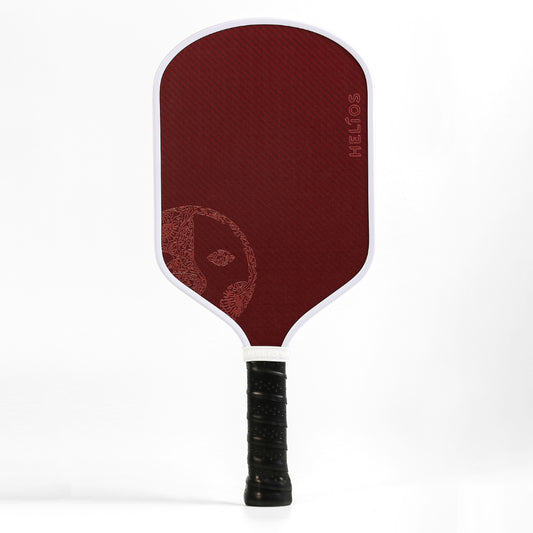
Helios takes a middle path. The performance paddles use Toray T700 carbon fiber with a particle printed finish applied on top. This finish adds a controlled texture layer that increases ball dwell time (how long the ball stays in contact) while protecting the underlying carbon from premature wear. The result is spin performance that sits close to raw carbon fiber out of the box but holds that performance level significantly longer. Compare models on the performance comparison page.
Who Should Use a Raw Carbon Fiber Paddle
Raw carbon fiber is not universally better. It is better for specific players in specific situations.
Use Raw If
- You prioritize maximum spin on topspin drives, slice serves, and shaped dinks.
- You are willing to replace or re-skin the paddle face when grit wears down
- You play competitively and want every legal advantage in spin generation
- You prefer the tactile, gritty feel of an unfinished surface
Use Coated or Particle Printed If
- You want consistent spin performance over months, not just weeks
- You play 3+ times per week and do not want to track surface degradation
- You value long-term durability and lower maintenance
- You prefer a smoother, more uniform feel at contact
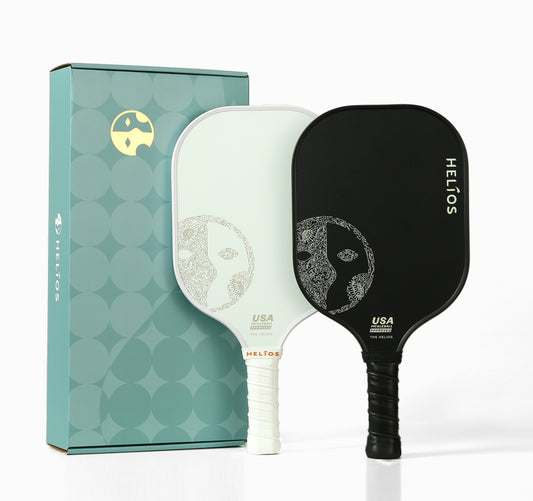
A paddle set from Helios gives you two paddles with particle-printed T700 faces, so you can rotate between them and extend the surface life of both.
How to Extend the Life of a Raw Carbon Fiber Face
If you choose raw carbon fiber, a few habits slow the degradation:
- Use a paddle cover during transport to prevent surface contact with zippers, keys, and bag contents
- Wipe the face with a dry cloth after every session to remove ball residue and grit
- Avoid dragging the paddle on the court surface
- Store in a cool, dry place (heat accelerates adhesive and surface breakdown)
- Consider a paddle skin when the original grit wears down. A peel-and-stick skin restores surface texture in under 5 minutes and is USAPA compliant.
Keep replacement overgrips and paddle skins in your bag alongside your accessories so a worn surface does not catch you mid-tournament.
What About Fiberglass and Kevlar
Not every player needs carbon fiber at all. Here is where the other two face materials fit relative to raw carbon.
| Face Material | Spin | Power | Feel | Durability | Best For |
|---|---|---|---|---|---|
| Raw carbon fiber | Highest | Controlled | Gritty, tactile | Lower (wears faster) | Spin-first competitive players |
| Coated/particle printed carbon fiber | High | Controlled | Textured, consistent | Higher | All-around performance players |
| Fiberglass | Moderate | Higher (more flex) | Softer, cushioned | Moderate | Beginners, touch-first players |
| Kevlar | Moderate | Moderate | Quietest, dampened | High | Arm-sensitive players, noise restrictions |
The Helios recreational line uses fiberglass faces for players who want a softer feel and a forgiving sweet spot. For most beginners and casual players, fiberglass is the better starting point because it rewards control and comfort over spin generation.
Raw Is a Tool, Not a Rank
A raw carbon fiber pickleball paddle is not objectively "better" than a coated one. It is a different tool for a different job. Raw gives you maximum spin potential at the cost of faster surface wear. Coated and particle-printed faces trade a small amount of peak spin for significantly longer performance consistency.
Pick based on your priorities: peak spin and willingness to maintain, or consistent performance with lower maintenance. Either way, the face material is only one piece of the puzzle. Core thickness, weight, shape, and grip all matter just as much. Browse the Helios collection to find the combination that fits your game.
Frequently Asked Questions
What does raw carbon fiber mean on a pickleball paddle?
Raw carbon fiber means the woven carbon fiber face is exposed without a protective coating, paint, or clear finish on top. The textured weave itself is the playing surface. That natural grit creates more friction at contact, which generates higher spin potential.
Is raw carbon fiber better than coated carbon fiber?
For maximum spin, generally yes. Raw faces have more natural friction points. But raw faces wear faster because there is no protective layer. Coated and particle-printed faces maintain their spin performance longer. The "better" choice depends on whether you prioritize peak spin or long-term consistency.
How long does a raw carbon fiber face last?
The grit noticeably decreases after 20 to 40 hours of play, depending on playing frequency and style. Heavy topspin players degrade the surface faster. A paddle skin can restore grit once the original texture wears down.
What is T700 carbon fiber?
T700 is a grade of carbon fiber made by Toray Industries. It is one of the most widely used grades in pickleball because it offers a strong balance of stiffness, durability, and weight. Helios paddles use Toray T700 with a particle-printed finish for extended spin performance.
Are raw carbon fiber paddles USAPA approved?
Yes, as long as the surface roughness stays under 30 micrometers. USA Pickleball applies the same limit to all approved paddles regardless of whether the face is raw, coated, or painted. Both raw and coated paddles are tested against the same standard.
What is the best raw carbon fiber pickleball paddle?
It depends on your playing style. For spin-first competitive play, the Six Zero Ruby and CRBN TruFoam Genesis are top raw-face picks in 2026. The Helios performance line uses T700 carbon with a particle-printed finish that delivers near-raw spin performance with better long-term durability. Compare options on the Helios performance comparison page.