Pickleball vs Badminton: Rules, Court Size & Which Sport Is Right for You

Pickleball and badminton get compared constantly, and it makes sense. Both are racquet sports played on similar-sized courts. Both can be played as singles or doubles. Both reward quick reflexes, sharp angles, and smart placement over brute strength. But the similarities end once you pick up the equipment and step on the court. The games feel completely different in practice, and understanding those differences is the fastest way to figure out which one fits you.
Whether you are a badminton player curious about making the switch, a pickleball player wondering what badminton is all about, or someone new to both sports entirely, this badminton vs pickleball breakdown covers everything you need to know: court dimensions, net height, equipment, rules, scoring, physical demands, and the question everyone wants answered: which one should I play? Let us get into it.
Pickleball vs Badminton: A Side-by-Side Breakdown
From court dimensions and net height to equipment, scoring systems, and physical demands, every major factor in the badminton vs pickleball debate reveals distinct differences behind the surface-level similarities. Here is how the two sports stack up across the categories that matter most.
Badminton Court vs Pickleball Court: Size and Layout
One of the most surprising facts in the pickleball vs badminton comparison is that the courts are nearly identical in size. A standard doubles badminton court measures 44 feet long by 20 feet wide. A standard pickleball court? Exactly the same: 44 feet by 20 feet. That identical footprint is why so many recreation centers and gyms convert badminton courts into pickleball courts simply by lowering the net and adjusting the lines.
The differences show up in the details. In singles badminton, the court narrows to 17 feet wide, using only the inner sidelines. Pickleball uses the full 20-foot width for both singles and doubles. The pickleball court also has a unique feature that badminton does not: the non-volley zone, commonly called the kitchen. It is a 7-foot area on each side of the net where players cannot hit the ball out of the air. Badminton has no equivalent zone. In badminton, you can attack from anywhere on the court, including directly at the net. The kitchen is what gives pickleball its signature strategic rhythm, forcing players to dink, reset, and wait for the right moment to attack.
Net Height: A Bigger Difference Than You Think
The pickleball court size vs badminton court may be nearly identical, but the nets are dramatically different. A pickleball net stands 36 inches high at the sidelines and 34 inches at the center. A badminton net stands 5 feet 1 inch at the posts and 5 feet at the center. That makes the badminton net roughly 1.8 times higher than the pickleball net.
That height difference changes everything about shot selection and strategy. In badminton, clearing the net requires high, arcing shots, steep smashes, and precise drop shots that just clear the tape. In pickleball, the lower net encourages direct, low-trajectory shots like dinks and drives. It also makes net play feel faster and more aggressive, because the ball does not need to travel upward as much before crossing to the other side. If you are used to one sport and trying the other, the net height adjustment will be one of the first things you notice.
Equipment: Paddles vs Racquets, Wiffle Balls vs Shuttlecocks
The equipment is where badminton vs pickleball really diverges. Badminton uses lightweight stringed racquets (typically 70 to 100 grams) and a shuttlecock, which is a feathered or synthetic projectile that behaves unlike any ball in any other sport. The shuttlecock decelerates rapidly after being hit, creating the distinctive float-and-drop flight pattern that makes badminton so unique. Pickleball uses solid-faced paddles and a perforated plastic ball similar to a wiffle ball. The ball travels slower through the air than a shuttlecock at peak speed but bounces off the court surface, which a shuttlecock does not do at all.
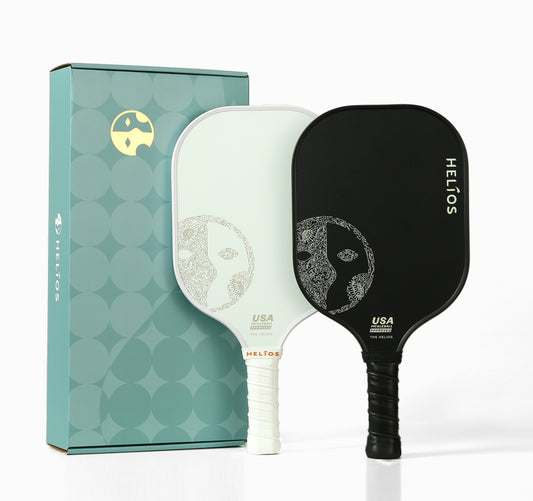
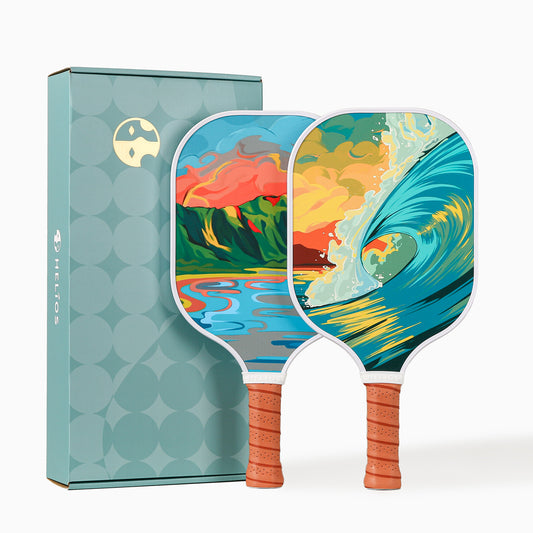
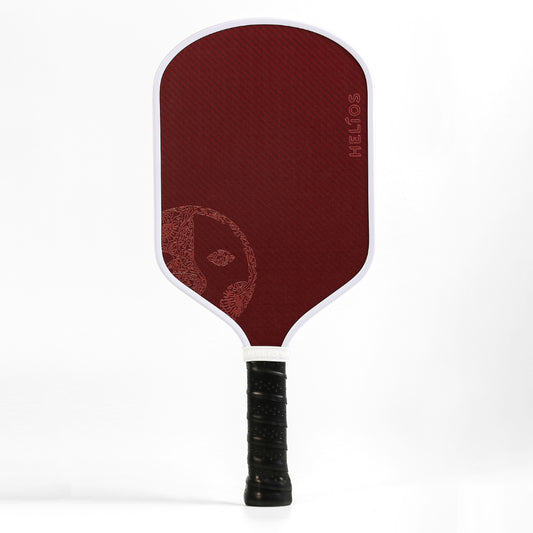
At Helios, our paddles are built with premium materials including carbon fiber, fiberglass, and Kevlar surfaces. Our Energy Series is handcrafted for balance, control, and feel, giving every player a responsive, performance-grade experience from the very first swing. For badminton players making the switch, the Helios Beginner Pickleball Paddle Set is an excellent starting point because it includes everything needed to get on the court right away.
Rules: How the Two Sports Differ in Play
Both sports use underhand serves, but the rules diverge quickly from there. Here is how the core rules compare.
Serving
In pickleball, the serve must be underhand, struck below waist level, and hit diagonally to the opposite service court. Each server gets one attempt. In badminton, the serve is also underhand, struck below the waist, and directed diagonally. However, badminton rallies can begin at full speed immediately after the serve, while pickleball has a double-bounce rule that slows the opening exchanges.
The Double-Bounce Rule
Pickleball requires the ball to bounce once on each side before volleys are allowed. That means the return of serve must bounce, and the third shot (the server's next hit) must also bounce. After both bounces have occurred, players can volley or let the ball bounce. Badminton has no bounce rule at all. The shuttlecock must never touch the ground during play. If it does, the rally is over.
The Kitchen (Non-Volley Zone)
Pickleball's kitchen is a 7-foot zone on each side of the net where volleys (hitting the ball out of the air) are not allowed. You can step into the kitchen to play a ball that has bounced, but you cannot stand in it and smash a volley. Badminton has no non-volley zone. Players can hit the shuttlecock from anywhere on the court, including right at the net. The kitchen is one of the defining strategic elements that separates pickleball from every other racquet sport.
Scoring
Pickleball games are typically played to 11 points, win by 2, with only the serving team able to score. Badminton games go to 21 points, win by 2, and either side can score regardless of who served. The scoring difference affects pacing: pickleball games tend to be shorter and more frequent, while badminton matches can be longer and more physically grueling.
Physical Demands: Which Sport Is Harder on the Body?
Badminton is the more physically demanding sport overall. The shuttlecock can reach speeds over 200 miles per hour in professional play, making it the fastest projectile in any racquet sport. Players sprint forward and backward constantly, jump for overhead smashes, and cover the full court with explosive lateral movement. A competitive badminton match demands serious cardiovascular endurance, leg strength, and agility.
Pickleball is a lower-impact alternative that still delivers a meaningful workout. The ball moves slower, the court is the same size but the action is more compact (especially in doubles), and the underhand serve eliminates the shoulder strain that comes with overhead serving in badminton. A typical pickleball session burns 300 to 500 calories per hour while building lateral agility, hand-eye coordination, and lower-body strength. For players looking for competitive fun without the same physical toll, pickleball is the gentler choice.
Pickleball vs Badminton: Which Sport Is Right for You?
The right sport depends on what you are looking for. Here is a quick framework.
Choose pickleball if: You want a sport that is easy to pick up, social by design, and gentle on joints. Pickleball's doubles format encourages teamwork and conversation, the kitchen creates a strategic layer that rewards patience and placement, and the lower physical demands make it sustainable for daily play across a wide age range. It is the fastest-growing sport in the United States for good reason.
Choose badminton if: You want a high-intensity workout that tests your speed, reflexes, and endurance at an elite level. Badminton's rapid pace, overhead smashes, and full-court movement provide a cardiovascular challenge that few other racquet sports can match. It is one of the most popular sports globally and has a well-established competitive circuit through the Olympics and the BWF.
Choose both if: You want variety. The skills transfer remarkably well between the two sports. Hand-eye coordination, lateral footwork, net awareness, and shot-making instincts all carry over. Playing both keeps your body challenged in different ways and prevents the repetitive-use patterns that can lead to overuse injuries in any single sport.
Making the Switch: Badminton Players Coming to Pickleball
If you are a badminton player interested in trying pickleball, you already have a head start. Your hand-eye coordination, wrist speed, and court awareness translate directly. The biggest adjustments are learning the kitchen rules, developing soft touch for dinks and drops, and getting used to a heavier, solid-faced paddle instead of a light racquet. At Helios, our Selene is a natural fit for badminton crossover players who rely on precision and placement, while The Astraeus suits players who want an all-court paddle that rewards both finesse and aggression. Add our Organic Overgrip for a customized grip feel, and the On The Court Tote Bag to carry your gear in style.
Frequently Asked Questions
Are pickleball and badminton courts the same size?
Almost. A standard pickleball court and a doubles badminton court are both 44 feet long by 20 feet wide. The key differences are net height (pickleball's net is roughly half the height of badminton's) and court markings (pickleball has a 7-foot non-volley zone called the kitchen that badminton does not have).
Is pickleball easier than badminton?
For most beginners, yes. Pickleball has a simpler scoring system, a slower ball speed, and an underhand serve that is easy to learn quickly. Badminton demands more technical skill, faster reflexes, and greater physical endurance, especially at competitive levels.
Can you play pickleball on a badminton court?
Yes. Because the court dimensions are identical for doubles play, many facilities convert badminton courts to pickleball courts simply by lowering the net and adding pickleball-specific line markings. It is one of the easiest court conversions in any racquet sport.
Which sport burns more calories, pickleball or badminton?
Badminton typically burns more calories per hour due to its faster pace, overhead movements, and full-court sprinting. A competitive badminton session can burn 400 to 600 calories per hour. Pickleball burns 300 to 500 calories per hour, making it a meaningful workout with lower impact on joints.
What skills transfer from badminton to pickleball?
Hand-eye coordination, lateral footwork, wrist speed, net awareness, and shot placement all transfer directly. Badminton players who try pickleball typically progress faster than complete beginners because they already have the athletic foundation that racquet sports demand. A quality paddle like The Helios helps crossover players feel comfortable and confident from the very first session.