Pickleball Stacking: What It Is and How to Master the Technique

You have probably watched doubles players line up on the same side of the court, then slide into different positions after the serve. That movement is called stacking, and it gives teams a serious edge.
Here is the thing most players get wrong: they assume you must alternate sides after every point. In reality, the rules only require the correct server and receiver to be in position. Where does your partner stand? Completely up to you.
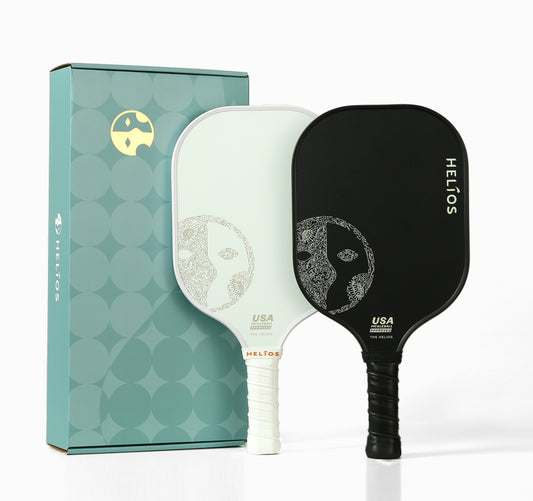
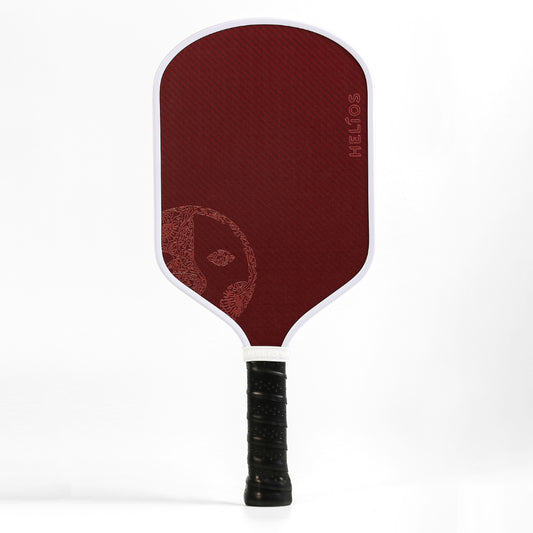
Once you get the hang of stacking, you will keep your strongest shots in play regardless of the score. Pair that knowledge with a paddle built for precision, like our Helios paddle, and you have a recipe for winning more points at the net.
So, What Exactly Is Stacking?
Stacking is a doubles strategy where both players line up on the same side of the court before the serve or return. After the ball is struck, each player shifts to their preferred position.
In traditional positioning, you and your partner switch sides based on the score. Stacking overrides that pattern and lets each player stay on the side where they perform best.
Why Would You Even Want to Stack?
Teams stack for several reasons:
- Keep forehands in the middle: Most points are won or lost in the center of the court. Positioning your stronger forehand there gives you better angles and faster reaction time.
- Lefty-righty combinations: When one player is left-handed and the other is right-handed, stacking puts both forehands in the middle. Opponents suddenly have no weak side to attack.
- Hide a weakness: If your backhand needs work, stacking can keep you positioned where that weakness rarely gets exposed.
- Maximize mobility differences: A more agile player can take the side that requires covering overheads or chasing lobs for a less mobile partner.
Hold On, Is Stacking Even Legal?
Absolutely. According to USA Pickleball Rule 4.B.7, the only positioning requirement is that the correct server serves from the correct court, and the correct receiver returns from the correct court. Partners can stand anywhere on their side of the net, including off the court entirely.
How to Stack When Your Team Is Serving
Imagine your partner is serving from the right side, but you prefer playing on the right. Instead of standing on the left (traditional position), stand behind your partner near the baseline or just off the court to their right.
After your partner serves, both of you slide left. Your partner moves to the left side, and you step into the right side where you wanted to be. You are now in your preferred positions without breaking any rules.
What About When You Are Receiving?
Receiving requires a slightly different setup. The player returning serve stands at the baseline in the correct court. The partner waits at the kitchen line, but positions themselves off the court near the sideline.
Once the return is struck, the partner steps onto the court, and both players slide into their preferred positions. The returner hustles to the kitchen line on the opposite side.
Hand Signals That Make Life Easier
Communication is everything when stacking. Many teams use simple hand signals behind the back so opponents cannot see:
- Open palm (five fingers): "Let's switch" or "Let's stack."
- Closed fist: "Stay where you are."
Some teams also use a signal for a fake stack, making opponents guess where the players will end up

When Does Stacking Actually Make Sense?
Stacking works best when:
- You have a lefty-righty partnership.
- QOne player has a significantly stronger forehand or third-shot drop.
- You want to exploit a specific weakness in your opponents.
- One partner is faster and can cover more ground on a particular side.
Stacking may not be worth the extra movement if both players are equally skilled on either side. Practice it in recreational games before bringing it to competition.
The Right Paddle Makes Stacking Even Better
Stacking puts your strongest shots in play more often. A paddle that complements your style helps you capitalize on that advantage.
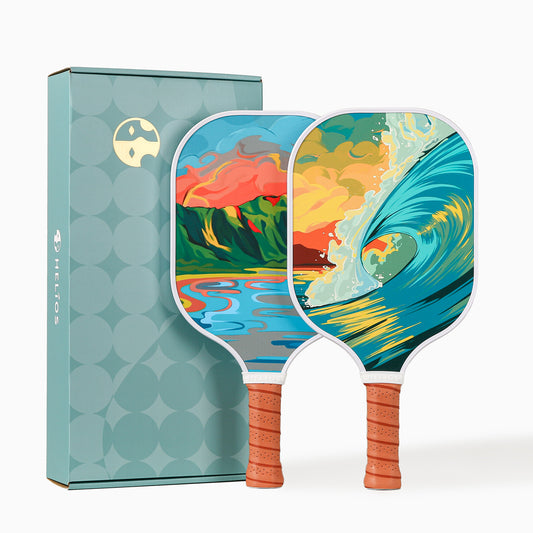
At Helios, we build paddles for players who want both power and precision. Our Helios paddle offers excellent control. The Apollo delivers more pop for aggressive drives from the left side. Want to practice stacking with a partner? The Selene Swift Paddle Set gives you two performance paddles to dial in your strategy together.
Frequently Asked Questions
Q: Can I ask the referee if I'm in the correct position?
Yes. Rule 4.B.8 allows any player to ask the referee for the score, who the correct server or receiver is, and whether anyone is in the wrong position.
Q: How do I remember which side to serve from when stacking?
Track the first server. If you started the game serving first, you serve from the right when your score is even and from the left when your score is odd. Your partner follows the opposite pattern.
Q: Is stacking only for advanced players?
Not at all. Intermediate players benefit from stacking, too, especially lefty-righty partnerships. Start simple and add complexity as you get comfortable.
Q: Can I stack on some points and not others?
Absolutely. Many teams only stack when the score or matchup makes it beneficial. Flexibility is part of the strategy.