What Are the Pickleball Rules Every Player Must Know in 2026?
Table of Contents
- How to Start Playing Pickleball by the Rules
- What Equipment Do Pickleball Rules Require
- Where Can You Legally Play Pickleball According to Official Rules
- How Does Pickleball Scoring Work in Tournament Play
- What Are the Most Confusing Pickleball Rules Players Break
- Why Do Pickleball Serving Rules Matter for Competitive Play
- When Do Pickleball Fault Rules Apply During Games
- How to Handle Pickleball Line Call Disputes Properly
Stepping onto the Court Without Knowing the Rules? Bad Idea.
You grab a paddle, head to the court, and suddenly someone yells "kitchen violation!" You had no idea stepping into that painted zone was illegal. Another point lost because you served from the wrong side. Another argument about whether the ball was in or out.
Sound familiar? Most new players jump into pickleball without understanding basic pickleball rules, and confusion follows. You can't play confidently when you're guessing at what's legal. Worse, you'll lose points to opponents who know exactly what the rulebook says.
What are pickleball rules, really? More than just guidelines, rules are the framework that makes fair play possible. Whether you're hitting with neighbors on a driveway court or entering your first tournament, knowing official pickleball rules 2026 gives you the confidence to compete without second-guessing every move.
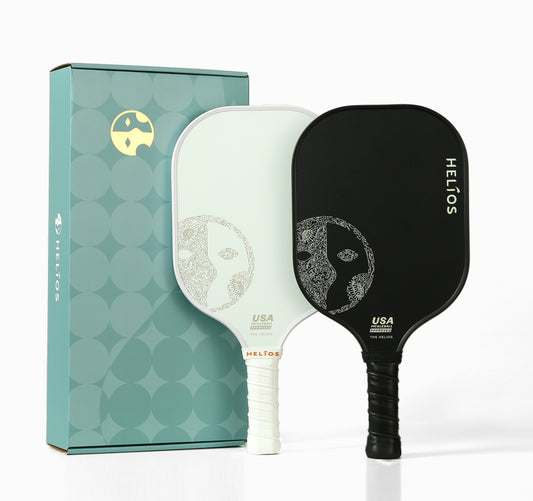
Getting serious about the game? You'll need equipment that matches your commitment. The Helios features USAPA-approved construction with a 13mm reactive core and carbon fiber surface designed for players who respect the rules and demand performance that rewards proper technique.
How to Start Playing Pickleball by the Rules
Basic pickleball rules start with understanding the court itself. The playing area measures 20 feet wide by 44 feet long, the same dimensions for both singles and doubles. The net hangs 36 inches high at the sidelines, dipping to 34 inches at the center.
Court Zones That Define Legal Play
The pickleball court layout divides into specific zones, each with unique restrictions:
The Kitchen (Non-Volley Zone): A 7-foot area on both sides of the net. Players cannot hit volleys while standing inside or touching the kitchen line. Step in before the ball bounces? Fault. Touch the line with your toe during a volley? Fault. The kitchen forces strategic play instead of aggressive net-smashing.
Service Courts: Each side splits into two 10-foot-wide by 15-foot-deep rectangles. The centerline divides right and left service areas. When serving, you must aim diagonally into the opponent's service court just like tennis, but with different serving rules.
The Two-Bounce Rule That Changes Everything
New players coming from tennis often miss the two-bounce rule (also called the double-bounce rule). After the serve, the receiving team must let the ball bounce once before returning. Then the serving team must let the return bounce once before hitting.
Only after both teams have let the ball bounce can players start volleying at the net. Without the two-bounce rule, pickleball would just become a power game dominated by who could smash hardest at the kitchen line.
Starting your beginner pickleball guide journey with quality equipment makes learning easier. The Gaia combines a textured Toray carbon fiber surface with a reactive honeycomb core perfect for beginners mastering shot control while learning proper court positioning.
What Equipment Do Pickleball Rules Require
Official pickleball rules 2026 specify exact equipment requirements for tournament play. Your paddle and ball must meet USAPA (USA Pickleball Association) standards, or you can't compete.
Paddle Specifications That Matter
Maximum dimensions: 24 inches combined length and width. No weight restrictions exist, but most paddles range from 7 to 8.5 ounces. The paddle face must be smooth and free of texture that gives unfair spin advantage though approved textured surfaces meeting USAPA standards are legal.
Surface materials approved include graphite, carbon fiber, fiberglass, and composite materials. Metal paddles? Not allowed. Paddles with holes, indentations, or rough sandpaper-like surfaces? Banned unless they meet specific USAPA-approved texture standards.
Your grip can have any length up to 5.5 inches, allowing for two-handed backhands if that's your style. The grip circumference typically ranges from 4 to 4.5 inches depending on hand size.
Ball Requirements for Fair Play
Approved pickleballs must be made of durable plastic with 26 to 40 evenly-spaced circular holes. Diameter between 2.874 and 2.972 inches. Weight between 0.78 and 0.935 ounces.
Indoor and outdoor balls differ. Outdoor balls have smaller holes and thicker plastic to handle wind and rough court surfaces. Indoor balls have larger holes and softer plastic for better control on smooth gymnasium floors.
Color? Usually yellow, white, or orange for maximum visibility. Some tournaments specify ball color to match court surface for fairness.
Looking for USAPA-approved paddles that exceed tournament standards? The Apollo features Toray T700 carbon fiber with maximum approved surface grittiness, thermoformed unibody construction, and a patent-pending accelerated core engineered for players who compete at the highest levels.
Where Can You Legally Play Pickleball According to Official Rules
How to play pickleball requires a proper court, but not all courts meet official standards. Tournament play demands specific measurements and markings.
Permanent Court Requirements
USAPA-sanctioned courts must have:
- Hard, smooth playing surface (concrete, asphalt, or specialized court tiles)
- Precise 20' x 44' playing area with proper line markings
- All lines 2 inches wide, considered in-bounds
- Minimum 30' x 60' total area including overrun space for safety
- Net posts positioned 22 feet apart, just outside the sidelines
- Proper lighting for indoor or evening play (minimum 30 foot-candles at court level)
Temporary Court Conversions
You can set up temporary courts on driveways, tennis courts, or parking lots. Use chalk, tape, or temporary line markers. Portable net systems work fine for recreational play, but tournament organizers require permanent installations.
Tennis court conversions are popular; one tennis court fits four pickleball courts when properly lined. Many communities now paint permanent pickleball lines on existing tennis courts for dual-purpose use.
Color Standards for Lines and Surfaces
Court surface color must contrast with white or yellow lines. Dark green, blue, or red surfaces work well. Light-colored surfaces need dark lines for visibility.
How Does Pickleball Scoring Work in Tournament Play
Official pickleball rules 2026 use rally scoring or traditional side-out scoring depending on tournament format. Understanding both prevents confusion.
Traditional Side-Out Scoring (Most Common)
Games typically go to 11 points, win by 2. Only the serving team can score points. When the serving team loses a rally, possession passes to the opponents called a side-out.
The score has three numbers called before each serve:
- Serving team's score (first number)
- Receiving team's score (second number)
- Server number (1 or 2, third number)
Example: "5-3-2" means the serving team has 5 points, the receiving team has 3 points, and the second server on the serving team is serving.
Starting the Game
The serving team starts with only one server (the player on the right side). After losing the first rally, side-out occurs and the other team serves. From then on, each team gets two servers per side-out.
Rally Scoring (Growing in Popularity)
Some tournaments now use rally scoring where both teams can score on any rally, regardless of who served. Games go to 15 or 21 points. Rally scoring speeds up matches and reduces serving advantage.
Calling the Score
The server must call the score loudly before serving. If you call the wrong score, opponents can challenge before the return. The referee decides if the serve stands or replays.
For paddles that reward consistency during long tournament matches, The Selene weighs just 7.8 ounces with an elongated shape and Toray T700 carbon surface built for players who need lightweight maneuverability without sacrificing power through grueling tournament days.
What Are the Most Confusing Pickleball Rules Players Break
Even experienced players regularly violate pickleball rules without realizing what happened. Knowing common mistakes prevents costly faults.
The Kitchen Line Mystery
Your toe touches the kitchen line during a volley. Fault. You volley the ball while standing behind the kitchen line, but your momentum carries you into the kitchen afterward. Still a fault.
The rule: You cannot enter the kitchen or touch the kitchen line until after the ball bounces. Hitting a volley while standing outside the kitchen, then stepping in? Legal only if you've reestablished both feet outside the kitchen before touching the line again.
The Serve Must Be Underhand
Basic pickleball rules require underhand serves with specific mechanics:
- Contact point below the waist
- Paddle head below the wrist at contact
- Upward arc motion
- Both feet behind the baseline until after contact
Players coming from tennis often serve overhand or with wrist above paddle head immediate fault.
The Double Bounce Violation
Rushing to the net after serving and volleying the return? Fault. The serving team must let the return bounce before hitting. New players forget constantly.
The Out-of-Turn Serving Error
Serving from the wrong side or when the wrong partner should be serving results in a fault, loss of serve, and point subtraction if the error isn't caught immediately. Always check the score before serving.
The Carry or Double Hit
Scooping the ball or hitting twice in one motion? Illegal. The ball must be struck cleanly in a single motion. No lifting, carrying, or directing the ball.
Why Do Pickleball Serving Rules Matter for Competitive Play
Serving rules in official pickleball rules 2026 are specific and strictly enforced. Violating serve mechanics costs you points and momentum.
Correct Serving Sequence
Only one player serves at the game's start the player on the right side. After side-out, both partners get serving opportunities before possession changes.
First server rules:
- Serves from the right court when score is even (0, 2, 4, 6...)
- Serves from the left court when score is odd (1, 3, 5, 7...)
- Continues serving and switching sides until losing a rally
After the first server loses a rally, the second server takes over. When the second server loses a rally, side-out occurs.
Proper Serving Technique
The ball must be dropped (not tossed up) and struck in the air below waist level. The drop serve alternative allows the ball to bounce once before striking simpler for beginners but less powerful.
Paddle head stays below the wrist at contact. The entire motion uses an upward arc. Contact happens below the naval.
Foot Faults on Serves
At least one foot must stay behind the baseline until after contact. Both feet can be in the air during contact, but you cannot step on or over the baseline until the paddle hits the ball.
Stepping on the baseline, even slightly? Fault. Serve doesn't count, and if both partners fault, side-out occurs.
For players who want serving power that complies with all regulations, The Blaze features an accelerated core and optimized widebody shape delivering explosive serves while maintaining control for precise placement in the service court.
When Do Pickleball Fault Rules Apply During Games
A fault ends the rally and results in either a point for the opposing team (rally scoring) or loss of serve (side-out scoring). Knowing when faults occur prevents unforced errors.
Common Fault Scenarios
Service faults:
- Serving out of turn or from wrong court
- Foot fault (stepping on or over baseline)
- Serving overhand or above waist level
- Ball landing in wrong service court or out of bounds
- Hitting the net on serve
Volleying faults:
- Volleying in or touching the kitchen line
- Hitting the ball before the two bounces complete
- Double hit or carry
General faults:
- Ball hits you or your partner
- Ball bounces twice on your side before returning
- You touch the net or net post with paddle, body, or clothing
- Ball lands out of bounds
- You or your partner enter opponent's court or interfere with shot
The Fault Doesn't End All Hope
In recreational play, faults happen constantly. Accept mistakes, call them honestly, and move on. Arguing about close calls damages relationships and ruins fun.
In tournament play, referees make official calls. Line judges help on close calls. Video review exists at professional levels but remains rare at amateur tournaments.
How to Handle Pickleball Line Call Disputes Properly
Line call disputes create the most tension in pickleball. What are pickleball rules for resolving disagreements fairly?
The Benefit of the Doubt Rule
In non-officiated games, the player on the side where the ball landed makes the call. If you can't tell whether the ball was in or out, you must call the ball in. The benefit of the doubt always goes to your opponent.
A ball touching any part of the line is in. Even the tiniest contact with the line means legal shot.
The Three-Call System
Most recreational players use the three-call system:
- In: Ball clearly touched the line or landed inside
- Out: Ball clearly missed all lines and landed outside playing area
- Uncertain: Cannot tell if ball touched line or not must be called in
When Disagreements Arise
Players can request a replay if both sides genuinely cannot agree. But replays should be a rare honor system that depends on honest calls.
In tournaments, referees and line judges make final decisions. Arguing with officials results in warnings, point penalties, or disqualification.
The Sportsmanship Standard
Call your own faults. If your partner steps in the kitchen during a volley and you notice but opponents don't, call the fault. Integrity matters more than winning through deception.
Rule Knowledge Separates Good Players from Great Competitors
Mastering pickleball rules transforms your game from casual recreation to serious competition. Knowing serving sequences, fault scenarios, and scoring systems prevents unforced errors that cost matches.
Official pickleball rules 2026 haven't drastically changed from previous years, but staying current prevents surprises at tournaments. USAPA updates equipment standards, tournament formats, and officiating procedures regularly.
The real advantage? Confident play without hesitation. When you know the rules cold, you focus entirely on strategy and execution instead of worrying whether your shot was legal.
Serious about competitive play? Your equipment should match your dedication. The Athos uses DuPont Kevlar, a bulletproof material combined with thermoformed construction and an accelerated core for explosive power. USAPA approved and backed by a lifelong warranty, the Athos rewards players who demand both rule-compliant design and championship performance.
Ready to compete with confidence? Visit Helios Pickleball to find USAPA-approved paddles engineered for players who respect the rules and refuse to compromise on performance.
Frequently Asked Questions
What are the 5 basic rules of pickleball?
The five core rules are: (1) serve underhand below waist, (2) two-bounce rule before volleying, (3) no volleying in the kitchen, (4) only serving team scores points in traditional scoring, and (5) games to 11, win by 2.
Has pickleball changed any rules in 2026?
USAPA continues refining equipment standards and surface texture regulations. Rally scoring gains adoption in more tournaments. Core gameplay rules remain consistent with 2024, maintaining the two-bounce rule, kitchen restrictions, and serving requirements for fair competition.
How do you start a pickleball game?
Decide which team serves first via coin flip or rally. The starting server begins from the right court, serving diagonally to opponent's right service court. Only one player serves initially; after side-out, both partners serve per side-out.
Can you volley right after the serve?
No. The two-bounce rule requires the receiving team to let the serve bounce once, then the serving team must let the return bounce once. Only after both bounces can players volley at the net or anywhere on court.
What counts as a fault in pickleball?
Faults include: volleying in the kitchen, foot faults on serve, failing to clear the net, hitting out of bounds, violating the two-bounce rule, double-hitting the ball, touching the net, and serving overhand or above waist level.
How does scoring work in doubles pickleball?
Traditional scoring requires three numbers: serving team score, receiving team score, and server number (1 or 2). Only the serving team scores points. Games go to 11, win by 2. Each team gets two servers before side-out.
What happens if the ball hits the kitchen line?
The ball touching any line is in. Kitchen line counts as part of the kitchen for foot placement but part of the playing area for ball bounces. A ball landing on the kitchen line is legal and in play.
Are there different rules for singles vs doubles pickleball?
Court dimensions stay identical. Singles scoring uses two numbers (your score, opponent's score) since no partner exists. Singles players cover the entire court alone, changing strategy but not core rules about serving, volleying, or kitchen restrictions.