How to Hold a Pickleball Paddle for Better Control and Power
Table of Content
- Why Your Paddle Grip Affects Every Shot You Make
- What Is the Continental Grip and Why Most Players Use It
- How to Find the Right Grip Size for Your Hand
- Where to Position Your Hands on the Paddle Handle
- How to Hold Your Paddle for Different Shot Types
- Common Grip Mistakes That Hurt Your Game
- How Paddle Weight and Handle Shape Impact Your Grip
- When to Adjust Your Grip During Play
- FAQ
Your Grip Controls Everything That Happens Next
Walk onto any court and watch closely. The players hitting precise dinks? Perfect grip. The ones sending balls flying over the baseline? Usually a grip problem.
How to hold a pickleball paddle isn't just another technique to memorize, it's the foundation of every single shot you'll ever make. A proper grip turns wobbly shots into weapons. An improper one? That's weeks of frustration wondering why your game won't click.
Most players grab a paddle and start swinging. Big mistake. What feels natural at first usually creates bad habits that take months to fix. The continental grip, finger placement, grip pressure pickleball control getting all of these right from day one changes everything.
Whether you're brand new or you've been playing for months with inconsistent results, fixing your grip fixes your game. Let's break down exactly where to hold a pickleball paddle and why each detail matters more than you think.
Why Does Grip Affect Every Shot You Make?
Hold a paddle wrong and watch what happens. Dinks sail long. Drives lack power. Volleys feel unpredictable. Your wrist gets sore after 30 minutes.
The Connection Between Hand and Paddle Face
Pickleball paddle positioning determines your paddle face angle on every hit. Too tight and your wrist locks up. Too loose and the paddle twists. Your hand needs to communicate with that paddle face telling it exactly where to go and at what speed.
When you nail the grip, you feel the ball. Not just physically, but you sense where your shot will land before contact even happens. That feedback loop between hand and paddle? That's what separates recreational players from competitors.
Power Generation Starts in Your Hand
Raw arm strength means nothing with a poor grip. Power comes from efficient energy transfer from your body through your arm, into your hand, through the paddle, and finally into the ball. Any weak link in that chain and you lose juice.
A solid pickleball grip guide approach maximizes every ounce of force you generate. The pros aren't necessarily stronger. Most just grip correctly, letting their paddles do the work instead of muscling every shot.
Looking for a paddle that rewards proper technique with explosive power? The Blaze features an accelerated core and optimized shape that delivers raw power without sacrificing control when your grip fundamentals are dialed in.
What Is the Continental Grip (And Why Everyone Uses It)?
Ask any coach about how to hold a pickleball paddle and you'll hear "continental grip" within 30 seconds. Not because it's trendy because it works for everything.
Setting Up the Continental Grip
Hold your paddle perpendicular to the ground with your non-playing hand. Now shake hands with the handle. That's close, but not quite there yet.
Your index finger's base knuckle should sit on the top-right bevel (if you're right-handed). Your thumb rests along the back-left surface of the handle. The V-shape between your thumb and index finger points toward your opposite shoulder.
That's it. No complicated finger gymnastics. Just a natural handshake position with specific placement.
Why Continental Dominates All Other Grips
The continental grip handles forehands, backhands, volleys, and serves without adjustment. When balls come fast at the kitchen line, you can't waste time changing grips. Continental keeps you ready for anything.
Pickleball wrist technique improves dramatically with continental grip. Your wrist stays flexible enough to generate spin while maintaining stability for touch shots. The paddle face naturally angles slightly open, perfect for topspin drives and controlled dinks.
Want a paddle engineered specifically for quick net exchanges? The Flare features a Hybrid shape; it has a widebody-level" sweet spot" optimized for fast hands, rewarding your continental grip with devastating accuracy on rapid-fire volleys.
How Do You Find the Right Grip Size?
Wrong grip size forces compensation. You'll squeeze too hard, your hand cramps, and your forearm burns after one game. All preventable.
The Finger-Width Test
Grab your paddle with continental grip. Look at the space between your fingertips and palm. You want roughly one finger's width about 1/4 to 1/2 inch.
Too much space means the grip circumference is too large. You'll grip harder to compensate, leading to arm fatigue and reduced control. Fingers touching your palm? Too small. The paddle will twist on hard shots.
Standard Grip Sizes
Most paddles range from 4 to 4.5 inches in circumference:
Small hands: 4 to 4.125 inches Medium hands: 4.125 to 4.25 inches Large hands: 4.25 to 4.5 inches
Women typically prefer 4 to 4.25 inches. Men usually want 4.25 to 4.5 inches. But hand size varies test before buying.
Warning Signs of Wrong Grip Size
Your body tells you when something's off:
- Hand cramping during play
- Paddle rotating in your hand on powerful shots
- Blisters forming in unusual spots
- Needing to death-grip just to maintain control
- Forearm pain after 20 minutes
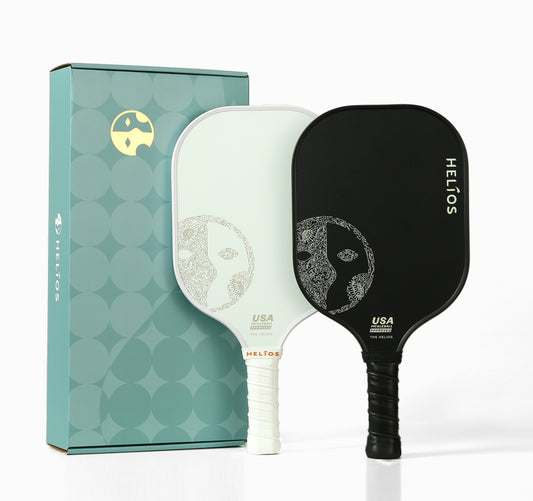
For players seeking a beginner-friendly paddle with excellent grip ergonomics, The Helios offers a 4.125, all Gen 3 paddle, so they are great to not get hand-tired with enhanced padding that reduces grip fatigue while maintaining precise control.
Where Should Your Hand Sit on the Handle?
To hold a pickleball paddle on the handle itself matters as much as how you grip it. Too high kills reach. Too low sacrifices control.
Optimal Hand Position
Position your hand so your index finger knuckle sits about 1-2 inches from the paddle's throat (where the handle meets face). Your pinky should rest fully on the handle with no gap between your palm and the butt cap.
No space should exist between your palm and the handle's bottom. Some players let their pinky hang off terrible ideas. Every finger contributes to stability.
Individual Finger Placement
Index finger: Slightly separated from your other fingers. Creates a foundation for paddle stability and allows micro-adjustments to paddle angle.
Thumb: Positioned diagonally across the back surface. Never wrap it around to meet your fingers kills wrist flexibility. Never let it creep onto the paddle face creates instability.
Middle, ring, and pinky fingers: Wrapped naturally with consistent pressure. These three fingers prevent paddle twisting on off-center hits.
Two-Handed Backhand Considerations
Former tennis players often prefer two-handed backhands. Standard handles (5 inches) work fine for one hand but feel cramped with two.
The Selene features an extended 5.3-inch handle specifically designed for two-handed grips while maintaining the lightweight 7.8-ounce maneuverability needed for quick reactions at the net.
Also Read: What Is A Gen 3 Pickleball Paddle ?
How Should You Hold Your Paddle for Different Shots?
Continental grip works for everything, but subtle adjustments unlock maximum effectiveness for specific situations.
Serving and Returning Serves
Keep your standard continental grip. Focus on grip pressure pickleball technique instead: Start relaxed (around 4-5 on a 1-10 scale), then firm up to 7 at contact. Creates explosive power without tension buildup.
Kitchen Line Dinking
Slide your hand up the handle about one inch. Reduces swing weight for faster reactions. Lower your grip pressure to 3-4. You want the paddle almost floating in your hand for maximum touch.
Soft hands win dinking battles. Tight hands send balls long or into the net.
Baseline Power Drives
Move your hand back down to the handle's base for maximum leverage. Increase pressure to 7-8 at contact, but stay loose between shots. Arm fatigue kills power over time.
Mid-Court Volleys
Standard continental grip position works perfectly. Maintain moderate pressure (5-6 out of 10) for the ideal balance of touch and pop. No adjustments needed, just quick reactions.
Looking for a paddle that amplifies proper technique into devastating shots? The Sol features an elongated shape with an extended hitting surface, perfectly designed for aggressive baseline play when your grip mechanics are solid.
What Grip Mistakes Kill Your Game?
Even experienced players fall into grip traps. Recognizing problems is half the battle.
The Death Grip Problem
Strangling your paddle like you're afraid it'll escape. Squeezing at 9-10 intensity creates tension that travels up your forearm, through your elbow, into your shoulder.
Tense muscles are slow muscles. You lose reaction time and power. Plus, tennis elbow becomes almost inevitable.
The fix: Use the "bird in hand" method. Grip firm enough that a bird couldn't fly away, but gentle enough not to hurt it. Between shots, consciously relax to 3-4, then firm to 6-7 only at contact.
The Frying Pan Grip
Holding the paddle with your palm flat against the handle face or all fingers spread across the back. Completely locks your wrist.
You'll struggle with spins, dinks feel awkward, and your backhand becomes a weakness opponents exploit.
The fix: Return to continental basics. The paddle edge should bisect the V between thumb and index finger not sit flat in your palm.
Choking Up Too High
Hand nearly touching the paddle face. Sacrifices reach and leverage. Opponents will push you back with deep shots and you can't reach them.
The fix: Keep 1-2 inches of handle extending below your pinky. Gives you the reach advantage that pickleball paddle positioning experts recommend.
The Wandering Thumb
Letting your thumb creep onto the paddle face or wrap around to meet your fingers. Creates instability and prevents effective backhands.
The fix: Keep your thumb planted diagonally on the handle's back surface. Should feel like a support beam that never moves.
How Do Paddle Weight and Handle Shape Affect Your Grip?
Your grip doesn't exist in isolation. Paddle characteristics directly influence how to improve pickleball control through proper grip mechanics.
Weight Distribution and Grip Pressure
Heavier paddles (8.5+ ounces) require slightly looser grip pressure pickleball approach. The paddle's momentum does more work, so you don't need to squeeze as hard. Prevents arm fatigue over long sessions.
Lighter paddles (7.5-8 ounces) allow firmer grips without fatigue. Gives you more active control over paddle positioning.
Handle Length Matters
Standard handles (5 inches) fit single-handed grips perfectly. Extended handles (5.3+ inches) benefit two-handed backhands or players wanting extra leverage on serves and overheads.
Surface Material Impacts Grip Needs
Carbon fiber paddles generate more power with less effort. You can maintain a relaxed grip even on aggressive shots.
The Apollo features Toray T700 carbon fiber with USAPA-approved maximum grittiness, delivering instant feedback that lets you feel exactly how the ball responds to your pickleball grip guide technique.
For players seeking ultimate grip comfort with championship performance, The Athos features DuPont Kevlar construction combined with an ergonomic handle designed with added cushioning and textured faux-leather wrap for superior shock absorption.
When Should You Adjust Your Grip During Play?
Great players don't just learn one grip knowing when to make subtle changes separates good from elite.
Mid-Rally Pressure Adjustments
No time for major grip changes during fast exchanges. Focus on grip pressure modifications instead:
Defensive position: Lighten to 3-4 for quick reactions Attacking opportunity: Firm to 7-8 for power Kitchen warfare: Maintain 4-5 for balanced touch and speed
Situational Modifications
Windy conditions: Increase pressure by 1-2 points to maintain paddle stability on contact.
Sweaty hands: Never compensate with death-grip. Fix the equipment issue with overgrips or better anti-slip technology instead.
Fatigue management: When your forearm burns, you're gripping too tight. Take 30 seconds between games to shake out your arm and reset to proper pressure.
Practice Drills for Grip Awareness
Pressure scale drill: During warmup, hit shots at different pressures (3, 5, 7, 9) and feel how each level affects control and power. Builds automatic adjustment awareness.
Grip reset routine: Between every point, completely loosen your grip, then reestablish proper continental position. Prevents tension accumulation.
How Can You Test If Your Grip Works?
Your shots tell the truth about your grip quality. Look for specific performance indicators.
Signs Your Grip Is Solid
✓ Consistent paddle face angle on dinks and drops ✓ Minimal paddle twisting on off-center hits ✓ No hand cramping after 2-3 games ✓ Smooth transitions between forehand and backhand ✓ Confident volleys without constantly readjusting ✓ Natural topspin generation without excessive effort
Red Flags Indicating Grip Problems
✗ Balls consistently sailing long or dumping into the net ✗ Paddle turning in your hand on hard shots ✗ Calluses developing between thumb and index finger ✗ Feeling rushed to "reset" grip between shots ✗ Forearm fatigue within 30 minutes of play ✗ Inconsistent shot depth and placement
Performance doesn't lie. If you're seeing multiple red flags, your grip needs work.
Perfect Your Grip, Perfect Your Game
How to hold a pickleball paddle correctly transforms frustration into confidence. The continental grip, proper hand positioning, optimal grip pressure pickleball control, and knowing when to make adjustments nail all four and your game changes overnight.
But here's the reality: even perfect technique needs equipment that rewards it. Your grip only works as well as the paddle connected to it.
Helios Pickleball builds paddles around one principle fusing elegant design with championship-level performance. From the beginner-friendly The Gaia with its ergonomic handle and reactive core to the pro-level Toray Performance Set featuring unibody construction and accelerated cores every paddle features handles engineered specifically to reward proper grip technique.
Each Helios paddle comes with USAPA approval, a lifelong warranty, and a 30-day money-back guarantee. No risk. Just the promise of your best pickleball.
Your grip is dialed in. Now give it a paddle worthy of that technique. Browse the full Helios collection and feel the difference championship equipment makes when fundamentals meet innovation.
Frequently Asked Questions
How do you hold a pickleball paddle for beginners?
Beginners should use the continental grip, shake hands with the paddle, place your index finger knuckle on the top right bevel, keep thumb on back surface, and maintain firm but relaxed pressure around 5-6 out of 10.
Should I hold my paddle tight or loose?
Hold firm but relaxed at 5-6 pressure between shots, tightening to 7-8 only at contact moment. Death-gripping causes arm fatigue, reduces control, and limits power generation through locked muscles.
Where should my thumb be on the handle?
Position your thumb diagonally along the back-left surface of the handle (right-handers), creating support structure. Never wrap around the front or creep onto the paddle face kills wrist flexibility and backhand effectiveness.
How do I improve control when hitting the ball?
Use continental grip with proper finger placement, maintain relaxed 4-6 pressure, position hand 1-2 inches from paddle throat, and keep wrist flexible. Consistent paddle face angle comes from stable grip mechanics.
What grip do professional players use?
Over 90% of professional players use the continental grip for versatility across all shot types. Advanced players pair continental grip with high-performance paddles featuring Toray T700 carbon fiber for enhanced feedback and control.
Can the wrong grip cause arm pain?
Absolutely. Improper grip creates excessive tension causing tennis elbow, wrist strain, and shoulder pain. Proper grip with relaxed pressure prevents repetitive stress injuries and allows longer, pain-free play sessions.
How long does it take to get comfortable with a new grip?
Basic comfort develops within 5-7 practice sessions, but full natural integration requires 2-3 weeks of consistent play. Focus on proper form during drills before competitive play for faster, more permanent adaptation.
Does paddle weight affect how I should grip it?
Yes, Heavier paddles (8.5+ oz) perform best with slightly lighter grip pressure, while lighter paddles (7.5-8 oz) allow firmer grips without fatigue. Match your grip pressure to paddle weight distribution for optimal performance.