Custom Pickleball Paddle Materials: Which One is Right for You?

Building a custom pickleball paddle is about more than just choosing a color. The real decision is what materials go into your paddle. What face material do you want? What core construction? These choices define how your paddle plays, feels, and responds.
If you're serious about pickleball, understanding custom paddle materials matters. Your choice determines power delivery, control, forgiveness, and overall performance. Let's break down what each material does and who should be using it.
Paddle Face Materials: The Critical Choice
The face of your paddle is where the ball meets the equipment. This is the decision that shapes your entire game. Here are the main face materials available in custom paddles:
1. Carbon Fiber Faces
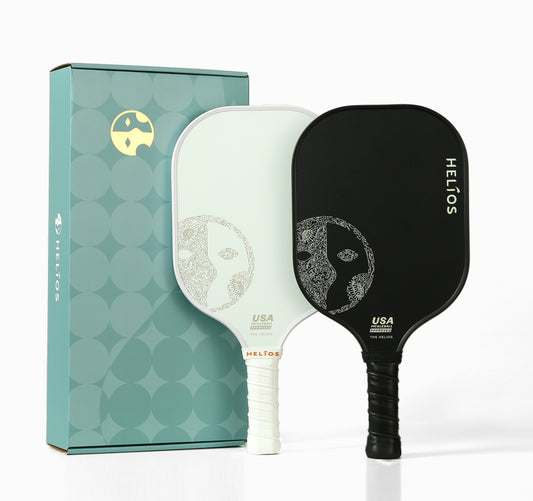
Carbon fiber is the choice for power and responsiveness. It's lightweight, crisp, and demands precision. Paddles like the Helios and Apollo showcase carbon fiber excellence.
- Maximum power: Crisp response generates exceptional power on drives and attacking shots.
- Precision feedback: You feel exactly what your technique is doing. Every mishit is obvious.
- Lightweight: Reduces arm fatigue during long tournaments and matches.
- Spin potential: Advanced players can generate serious spin with carbon fiber faces.
- Durability: Carbon fiber resists wear and maintains performance for years.
Best for: Advanced players who have solid technique and want maximum performance. Players who play regularly and want equipment that rewards good mechanics.
[[product:the-helios-pickleball-paddles]]
2. Fiberglass Faces
Fiberglass offers forgiveness and comfort. It's softer, gentler, and absorbs impact differently than carbon fiber. Models like the Gaia and Selene deliver this forgiving approach.
- Forgiving sweet spot: Off-center hits still deliver solid results without harsh feedback.
- Soft feel: Impact absorption creates a comfortable, cushioned response.
- Control-focused: Excellent for dinking, soft touch, and finesse plays.
- Lower learning curve: Better for developing players and beginners.
- Affordability: Fiberglass paddles cost less than carbon fiber options.
Best for: Intermediate players developing consistency. Anyone who values control over power. Players are building their fundamentals and wanting equipment that forgives mistakes.
[[product:the-gaia-pickleball-paddles]]
3. Graphite Faces
Graphite sits between carbon fiber and fiberglass. It's the balanced option for players who want both responsiveness and forgiveness. The Astraeus and Khione represent this balanced philosophy.
- Balanced performance: More responsive than fiberglass, more forgiving than carbon fiber.
- Versatile: Works for multiple playing styles and shot types.
- Good power generation: Solid punch without requiring perfect technique.
- Reasonable cost: Less expensive than carbon fiber, more durable than fiberglass.
- Control: Offers good control for soft shots while maintaining power potential.
Best for: Intermediate to advanced players who want a versatile paddle. Players who play different styles and want something that adapts to their game. Anyone seeking a balance between performance and forgiveness.
Paddle Core Materials: The Foundation
The core is the internal structure of your paddle. It affects how the paddle absorbs impact, distributes energy, and responds to your swing.
[[product:the-astraeus-pickleball-paddles]]
4. Polymer Core
Polymer cores are the most popular choice. They're made from plastic foam or honeycomb structures.
- Excellent touch: Outstanding control and feel across the paddle face.
- Quiet response: Creates a softer, less harsh sound on impact.
- Forgiving: Honeycomb structures absorb mishits and reduce vibration.
- Balanced: Works well with any face material for consistent performance.
- Affordable: Cost-effective option without sacrificing quality.
Best for: Most players. Polymer cores work across all skill levels and playing styles. The most versatile core option.
5. Aluminum Core
Aluminum cores provide a stiffer feel and more direct power transfer. They're less common but have dedicated users.
- Direct power: More responsive and immediate power delivery to the ball.
- Precision feedback: You feel every aspect of your shot.
- Durability: Aluminum is extremely durable and resistant to wear.
- Consistent performance: Doesn't soften or change over time.
- Weight distribution: Can be engineered for specific weight profiles.
Best for: Advanced players who want maximum feedback and power. Players are willing to sacrifice some forgiveness for direct responsiveness. Tournament players are seeking consistency.
6. Nomex Core
Nomex is an aramid fiber material. It's rare in custom paddles but valued for its explosive power delivery.
- Maximum power: Most explosive power delivery of any core material.
- Loud response: Creates a distinctive, loud sound on impact.
- Fastball speed: Generates exceptional ball velocity off the face.
- Less forgiving: Mishits feel significantly different from center hits.
- Specialist choice: For players specifically seeking power advantage.
Best for: Power-focused players who understand the tradeoff. Advanced players who can afford the precision required. Tournament players specifically build for baseline dominance.
Custom Paddle Material Combinations
The best custom paddles often combine different materials strategically. Here are popular combinations and what they deliver:

7. Carbon Fiber Face with Polymer Core
This is the balanced power setup. Carbon fiber delivers responsiveness while polymer keeps you forgiving. Excellent for competitive players who need both performance and consistency.
8. Graphite Face with Polymer Core
The all-rounder combination. Versatile, balanced, and works across multiple playing styles. Great for players who haven't settled on a single strategy.
9. Carbon Fiber Face with Aluminum Core
The precision specialist setup. Maximum feedback and direct power for advanced players who want to feel everything and deliver consistent power.
10. Fiberglass Face with Polymer Core
The control specialist combination. Perfect for players building fundamentals and prioritizing soft touch over power. Forgiveness across the board.
Building Your Custom Paddle: The Process
When you design a custom paddle, you're making strategic choices about materials. Here's how to approach it:
- Assess your skill level and what you prioritize. Power, control, forgiveness, or balance?
- Choose face material based on your technique and playing style. Advanced players typically prefer carbon or aluminum. Developing players prefer fiberglass or polymer.
- Select core material that complements your face choice. Polymer works with everything. Aluminum pairs well with carbon for precision.
- Consider your budget. Carbon fiber costs more than fiberglass. Aluminum cores cost more than polymer.
- Test if possible. Demo paddles with your chosen combination before committing.
- Remember that materials aren't everything. Shape, weight, and grip matter too. Consider the complete package.
Choose Materials That Match Your Game
Building a custom paddle is about understanding what each material does and choosing combinations that support your playing style. Carbon fiber delivers power. Fiberglass delivers forgiveness. Graphite delivers balance. The right choice is the one that matches how you actually play.
Your custom paddle is an extension of your game. Take time to understand the materials. Demo options if you can. Then build something that feels like you. Our collection showcases different material approaches. Browse our paddle collection and find the material combination that matches your vision. Contact us today to get your custom paddle and start this amazing journey.
Build your paddle. Own your game. Play with purpose.
Frequently Asked Questions
What material is best for beginners?
Fiberglass face with polymer core. Forgiving mistakes, a comfortable feel, and it helps you develop fundamentals without punishing every mishit.
Can I upgrade my paddle materials later?
Absolutely. Many players start with fiberglass or graphite, then upgrade to carbon fiber once they've developed consistency and technique. Your custom paddle can evolve as you improve.
Is carbon fiber always better?
Better depends on your definition. Carbon fiber is more responsive and powerful, but also less forgiving. For your specific game, a different material might actually perform better.
How much does material choice affect cost?
Significantly. Carbon fiber paddles cost more than fiberglass. Aluminum cores cost more than polymer. Custom configurations range from budget-friendly to high-end, depending on material selection.
Do professional players customize their paddles?
Yes, most advanced and professional players have custom or heavily tweaked paddles. They've found the exact material combination that works for their game and stick with it.
How do I know if my materials are working?
Play with them. Notice how the paddle feels on different shots. Do you have enough power? Is the control good? Is the sweet spot big enough? After 10 hours of play, you'll know if the material combination works for you.
Can I customize the face and core separately?
Yes. Many custom paddle builders let you choose face material and core material independently. This flexibility lets you create the exact combination you want.